It is with feelings of deep regret that we have to announce the almost sudden death of the Rear-Admiral of the United Kingdom, Admiral Sir Phipps Hornby, G.C.B., which occurred on Tuesday last, at his seat, Little Green, near Petersfield. We insert elsewhere a brief summary of the services of the deceased, but we may be permitted to say here that a more gallant and more gentle spirit has rarely passed from this world than that which animated one of the last survivors of the famed battle of Lissa.
The subjoined account of the career of the late Admiral Sir Phipps Hornby, G.C.B, is mainly taken from the pages of O’Byrne:—Phipps Hornby, born April 27, 1785, was fifth son of the Rev. Geoffrey Hornby, rector of Winwick, Lancashire, by the Hon. Lucy Stanley, sister of Edward, twelfth Earl of Derby; brother of Lieutenant-Colonel Charles Hornby, of the Scots Fusilier Guards; uncle of the present Earl of Derby. This officer entered the Navy May 19, 1797, as midshipman, on board the laltona, frigate, Captain John Bligh, bearing the flag Hon. William Waldegrave, at Newfoundland, where, removing successively to the Romney, 50, and Agincourt, 64, he served with the same officers until 1800. He next cruised for several months in the Channel on board the Active, frigate, Captain John Giffard, and then rejoining Captain Bligh in the Theseus, 74, was for upwards of two years employed with him in the West Indies, on which station we find him repeatedly engaged in cutting out armed and other vessels from the enemy’s different ports and harbours in St. Domingo. In July, 1803, he returned home in the Santa Margarita, 36, Captain Wilson Rathbone, and in the spring of the following year he sailed in the Leviathan, 74, Captain Henry William Bayntun, for the Mediterranean, where, on August 1, 1804, he was promoted from the Victory, 100, flagship of Lord Nelson, to an acting lieutenancy in the Excellent, 74, Captain Frank Sotheron—an appointment which the Admiralty confirmed by a commission dated on November 16 ensuing. In May, 1806, besides serving on shore at the defence of Gaeta, Mr. Hornby was entrusted with the command of the seamen and marines during the operations connected with the capture of the island of Capri. He soon afterwards joined the Swiftsure, 74, Captain William George Rutherford and on August 15, 1806, was promoted to the command of the Duchess of Bedford, of 16 guns. In that vessel, when in the Gut of Gibraltar, he succeeded in beating off two Spanish privateers who had endeavoured to carry her by boarding. Captain Hornby's next appointment was, about February, 1807, to the Minorca, 18, in which sloop, previously to visiting the Adriatic, he came into frequent contact with the enemy’s gunboats and batteries, both in the vicinity of Cadiz and while employed in the blockade of Ceuta, a port on the coast of Morocco. On March 31, 1810, he was appointed (having been advanced to post-commission on the 16th of the preceding month) to the temporary command of the Fame, 74, pff Toulon. On his proximate removal to the Volage, 22, he co-operated for some time in the defence Sicily against the threatened invasion of Murat; and on March 13, 1811, he had the honour of enacting a conspicuous part in the celebrated action off Lissa, when a British squadron, carrying in the whole 156 guns and 879 men, defeated, after a shattering battle of six hours, and a loss to the Volage of 13 killed and 33 wounded, a Franco- Venetian armament, whose force amounted to 284 guns and 2,655 men. The brave and gallant conduct displayed on the occasion by Captain Hornby, who himself received a slight wound, was rewarded by the Admiralty with a gold medal. He continued in the Volage until October, 1811, and was next, on August 6, 1812, and December 3, 1814, appointed to the command of the Stag, 36, and Spartan, 38. In the former of those frigates he made a voyage to the Cape of Good Hope; and on returning in the latter to the Mediterranean, he was employed as senior officer, in conjunction with a Tuscan land-force, to secure the accomplishment of a treaty stipulative of the surrender to Tuscany of the island of Elba by the French. For this service Captain Hornby was presented by the Tuscan Government with the Cross of the Imperial Order of St. Joseph of Wurtzbourg. He paid the Spartan off in July, 1816, and from that period remained unemployed until 1832, when he was appointed Superintendent of the Royal Naval Hospital and Victualling Yard at Plymouth. He removed, January 6, 1838, to the command of the William and Mary yacht, and the superintendentship of the Dockyard at Woolwich; and from December 16, 1841, until promoted to flag rank November 9, 1846, he filled the office of Comptroller-General of the Coast-guard. Sir Phipps was made a vice-admiral on January 1, 1854, and an admiral on June 15, 18S8. Sir Phipp’s last service was as Commander-in-Chief in the Pacific, where he had his flag flying on board the Asia. He subsequently was Lord of the Admiralty under the Government of his nephew, the present Earl of Derby, but for the last few years he declined all employment and lived in retirement at his country seat. Sir Phipps’s only surviving son is Commodore G. T. P. Hornby, now serving on the West Coast of Africa.
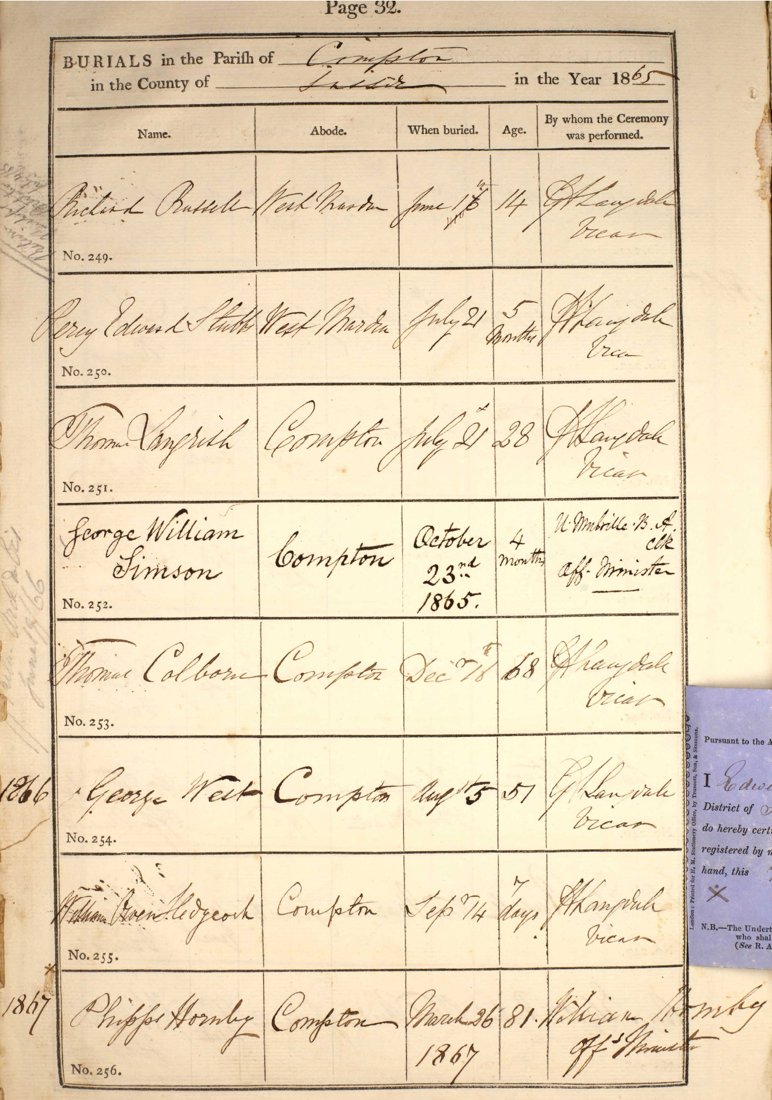
Ancestry shows Sir Phipps Hornby buried at Compton, Sussex, 26-Mar-1867